11월 05, 2025
|10분

새로운 Search Console Insights 기능은 단순한 리포트 “정리” 그 이상입니다. B2B 마케터에게 이는 높은 의도를 가진 구매자 요구와 신흥 시장 트렌드를 식별하는 AI 기반의 전략적 신호입니다.
Google은 최근 Search Console Insights에서 “Query Groups”를 도입했고, 목표는 비슷한 사용자 의도를 반영하는 쿼리 변형을 묶어 분석하기 덜 번거롭게 만드는 것이라고 밝혔다.
고관여도 높고 로우 볼륨, 높은 의도를 가진 키워드로 작업하는 B2B 마케터에게 “덜 번거롭다”는 표현은 과언에 가깝습니다. 이것은 단순한 정리가 아니라, 미래를 예측하는 도구입니다.
지속적으로 남아 있던 도전은 단편화된 롱테일 쿼리들을 엮어 복잡한 구매자들이 실제로 해결하려는 문제를 이해하는 것이었습니다. 지금까지는 느리고 수동적인 분석이 필요했습니다.
이 업데이트로 Google의 AI가 마침내 무거운 작업을 처리합니다. 우리의 작업을 키워드 보고서에서 의도 분석으로 이동시키며, B2B SEO의 근본적인 진전을 이루는 중요한 한 걸음입니다.
전략으로 들어가기 전에, Query Groups 업데이트가 실제로 무엇인지 간단히 살펴보겠습니다.
구글의 발표에 따르면, 새로운 “Queries leading to your site” 카드 in Search Console Insights는 이제 다음과 같이 작동합니다: Group Similar Queries: 비슷한 사용자 의도를 반영하는 쿼리 변형(오타, 다른 표현들)을 하나의 “그룹”으로 묶기 위해 AI를 사용합니다. 주석: 그룹은 동적으로 계산되며 진화할 수 있으며, 검색 순위에는 영향이 없습니다. Show Group Performance: 개별 용어의 클릭만 보는 대신 그룹 전체의 총 클릭수를 보여주어 고수준의 관점을 대폭 개선합니다. Provide a Drill-Down: 이는 핵심입니다. 어떤 그룹이든 클릭하면 성과 보고서로 이동하여 그 그룹을 구성하는 모든 개별적이고 세부적인 쿼리를 확인할 수 있습니다. Spotlight Trends: 이 카드는 자동으로 “Top” by volume, “Trending up” (가장 큰 클릭 증가), “Trending down” (가장 큰 클릭 감소)로 표시되는 그룹을 보여줍니다. 이 기능은 앞으로 몇 주에 걸쳐 점진적으로 도입되며, 쿼리의 양이 많은 사이트에서만 사용할 수 있습니다. 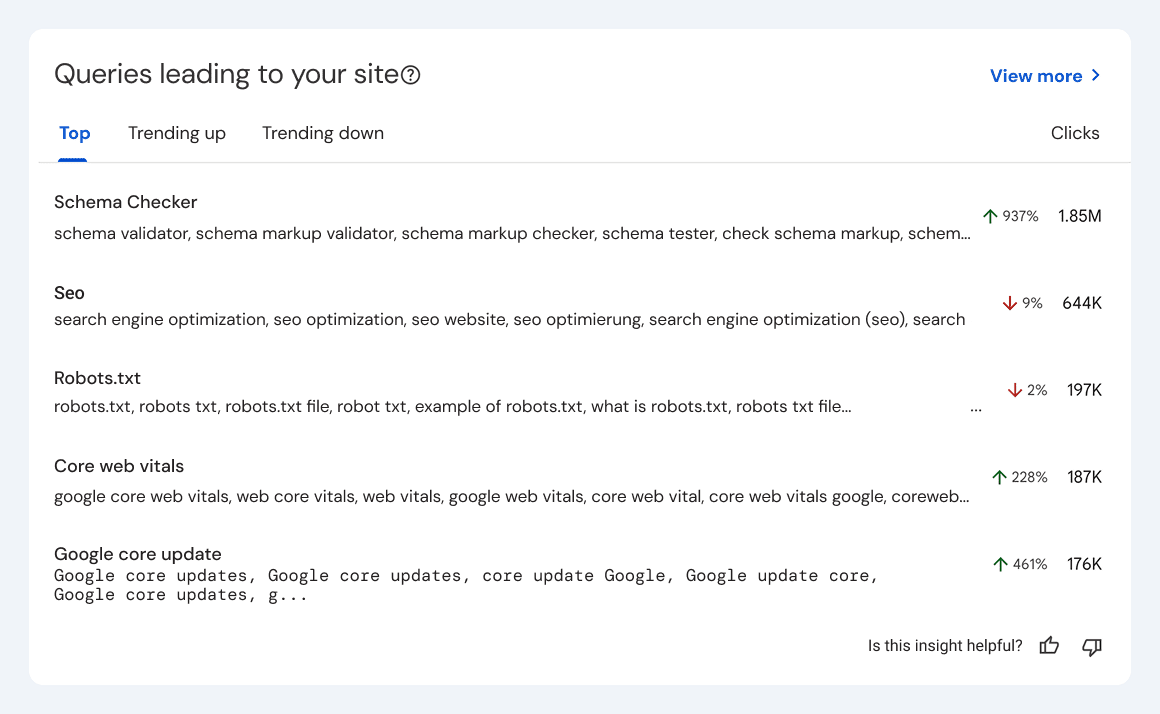 Image source 이제 기본 내용을 다뤘으니, 이 기능들이 B2B 마케터에게 실제로 의미하는 바를 살펴보겠습니다.
What Google Says: “Query groups solve this problem by grouping similar queries… they reflect a similar user intent.” For years, the most contentious debate in B2B content strategy meetings has been around structure. “Is this one big pillar page, or five separate blog posts?” 우리는 다 거기에 있었습니다. 귀하의 SME(주제 전문가)가 “kubernetes cost monitoring” 및 “finops for EKS best practices”은 완전히다른 주제들입니다. SEO 관리자는 키워드 도구를 사용해 이들이 의미상으로 연결되며 같은 페이지에 있어 권위를 구축해야 한다고 주장합니다. 결과는? 키워드 남용의 전형적인 사례처럼 보이는 대신, 같은 주제군의 조합으로 구성된 페이지의 균형 잡히고 집중된 구조로 변합니다. 이 업데이트는 논쟁을 끝냅니다. <강력한 AI 기반의 객관적 조정자인 Google이 등장합니다. ‘kubernetes cost monitoring’, “finops for EKS best practices”, 그리고 “how to reduce GKE egress fees”를 단일 그룹으로 묶는다면, Google은 단순히 보고서를 ‘정리’하는 것이 아닙니다. 사용자 의도에 대한 확정적 진술을 만들고 있습니다. 다음과 같이 말합니다: “동일 인물이 이러한 모든 항목을 같은 문제 해결 여정의 일부로 검색한다.” 이 기능은 콘텐츠 클러스터를 은빛 접시 위에 올려 제공합니다. The Old Way (Pre-Query Groups): 다음과 같이 볼 수 있습니다:
Your Action: You assign four different, 1,200-word blog posts to your content team. Your engineering resources are stretched thin writing them, and your authority on the overall topic is diluted across four separate URLs. The New Way (With Query Groups): You log into GSC Insights and see one card:
Your Action: You greenlight [X8134XX]i>one authoritative, 3,500-word pillar page titled “The Ultimate Guide to Kubernetes Cost Management & FinOps.” Then, you click the “drill-down” feature and hand the list of granular queries to your writer. Those queries become your H2s, H3s, and FAQ schema:
This isn’t just more efficient; it’s more effective. You’re creating the exact comprehensive resource Google’s AI has already identified as matching the full spectrum의 전체 범위의 전체 의도. You’re no longer guessing at semantic relationships; you’re using Google’s own map. This is gold for mapping content directly to your buyer’s journey, from early “what is” questions to later “how-to” problem-solving.
What Google Says: “You can click any group and be directed to the performance report to see all the individual, granular queries that make up that group.” When B2B marketers first saw the “Query Groups” announcement, we all felt a jolt of “not provided” panic. The fear that Google was abstracting away our most valuable, high-intent, long-tail data was very real. This single sentence—”you can click any group… to see all the individual, granular queries”—is the most important part of the entire announcement. The data isn’t gone. It’s not even hidden. It’s just been given a “boss.” This update isn’t about less data; it’s about <>i<>span style=”font-weight: 400;”>better-organized data. It gives us the best of both worlds: a high-level “executive summary” for our strategy and the “in-the-weeds” specifics for our execution. For B2B marketers, this structure is perfect. It solves a massive internal reporting problem: how to communicate performance to different stakeholders without overwhelming them.
Your CMO doesn’t have time to parse a 10,000-row CSV of query variations. They need the “so what.” The “Group” view is the “so what.” Your Report: “This quarter, our ‘Data Observability Platforms’ topic (a new Query Group) drove 40% of all new demo requests from organic. It’s our top-performing group. Meanwhile, our legacy ‘ETL Monitoring’ group is ‘Trending down,’ suggesting a market shift that we’re successfully capturing.” The Value: This is a clean, strategic narrative. You’re speaking in terms of market categories and topic performance, not just keywords. It directly ties content performance to the high-level business strategy. For Your Content & Product Teams (The “Drill-Down” View) This is where you, the marketer, find the real gold. You click that “Data Observability Platforms” group, and you get the raw, unfiltered voice of your customer. Your Report: “I drilled down into the ‘Data Observability’ group. The highest-click queries aren’t just generic. I’m seeing:
The Value (for Content): This is your next three-month editorial calendar. You now have proof that your audience is struggling with data transformation, cloud data warehouses, and data orchestration. You can write hyper-specific, problem-solving articles that you know have an audience, rather than guessing. The Value (for Product Marketing): This is a direct feed to your Product team. You can go to them and say, “The market is explicitly searching for ‘cloud data warehouse quality alerts.’ Our integration with cloud data warehouses is a key sales-enablement asset. We need a one-pager, a new landing page, and a webinar on this exact use case. The data proves it.” This two-tiered system allows you to manage up with strategic insights (the Group) and manage down with tactical, actionable data (the Drill-Down). It’s not an abstraction; it’s a built-in reporting framework that perfectly separates the “what” from the “why.”
What Google Says: The card groups queries by “Top,” “Trending up,” and “Trending down.” This is it. This is the feature that matters more than anything else. The “Top” groups are a vanity metric; the “Trending” groups are a compass. This one feature single-handedly transforms Search Console Insights from a historical report into a forward-looking, strategic dashboard. For B2B, where identifying a market shift six months before your competitors can mean capturing an entire new category, this is the whole game. This card is no longer an “SEO report” you send to your content team. It’s a “Market Intelligence Brief” you send to your heads of Product, Sales, and Demand Gen. Here’s how to use it.
When a B2C marketer sees a topic “trending up,” they think, “Great, a new blog post.” When a B2B tech marketer sees a new query group “trending up,” it’s an emergency flare. It’s a direct, unfiltered signal from the market that a new, urgent, and previously unarticulated <>span style=”font-weight: 400;”>problem is forming. This isn’t just an “SEO opportunity.” It’s a revenue opportunity. Example: A B2B SaaS company for DevOps teams sees a new group called [X17493Xspan style=”font-weight: 400;”>”AI-assisted code review” suddenly start “Trending up.” The Old (Reactive) Action: The SEO manager assigns a blog post: “What is AI-Assisted Code Review?” It gets 500 clicks. The New (Proactive) B2B Action: This is an all-hands-on-deck signal that informs your entire go-to-market motion: Product Marketing: You have a new, validated pain point. Is your product already solving this? If yes, you immediately spin up a new landing page, a one-pager, and a competitor comparison matrix. If no, you take this data directly to the product team as evidence for a new feature on the roadmap. Sales Enablement: Your sales team is likely hearing objections about this on calls right now. You use the “drill-down” feature to see the granular queries (“github copilot vs. custom code review”, “security risks of AI code review”). You immediately create a sales battlecard titled “Handling AI Code Review Objections” and a one-page PDF: “How Our Platform Complements (or Replaces) AI Review Tools.” Demand Gen: You have a new, high-intent topic before it’s saturated and expensive. You immediately launch a “test” paid search campaign against this query group and make it the theme of your next webinar. You are capturing demand while your competitors are still debating the blog title.
Just as valuable as knowing what’s next is knowing what’s over. In B2B tech, we waste millions of dollars in ad spend and content resources propping up “solved problems.” This feature is your permission to stop. When a “Top” group—especially one that has been a cash cow for you—starts “Trending down” for two or three consecutive periods, it’s not a blip. It’s a “sunset” signal. The market is moving on. The problem is either solved, or the terminology has changed. Example: A cloud data platform sees its core money-making group, “legacy data warehouse migration”, on a steady “Trending down” decline for six months. The Old (Panicked) Action: “SEO is down! Double the ad budget on these keywords! Refresh all the old migration blogs!” The New (Strategic) B2B Action: You accept the data. The market isn’t searching for “migration” anymore; they’ve migrated. Their new problems are different. Ad Budget: You immediately pull your expensive, low-performing ad budget from the “legacy migration” campaign. You re-allocate that entire budget to the new “Trending up” group (e.g., “multi-cloud data governance”) where you can be the dominant, first-mover voice. Content Strategy: You stop “refreshing” your 101-level migration content. Instead, you treat it as a “solved problem” and pivot. You create a new content cluster called “Post-Migration Optimization” and use your old “migration” posts to link up to this new, more advanced content, capturing the user in their next logical step. Customer Marketing: You alert your Customer Success team. This is a sign that even your existing customers are past their initial problem. It’s time to build retention and upsell campaigns focused on new problems, like “cost optimization” and “data quality,” not the problem you already solved for them.
나머지 마케팅 세계는 Google의 새로운 “Query Groups”를 전술적 SEO 업데이트로 받아들일 것입니다. “세부적인 쿼리 데이터의 손실”을 슬퍼하고, 이를 또 하나의 ‘not provided’ headache로 보게 할 것입니다. 그들을 두세요. B2B 기술 마케터들에게 이 업데이트는 전략적 선물입니다: 공식 발표는 일반적이지만, B2B에 대한 시사점은 깊습니다. 이는 10,000개에 달하는 롱테일 키워드 변형의 전술적 노이즈를 그만 obsess하고, 시장의 전략적 신호에 집중하라는 Google의 명시적 허가입니다. 이 새로운 대시보드는 더 이상 SEO 인턴이 몇 가지 키워드 격차를 찾는 도구가 아닙니다. 이는 리더십 팀을 위한 도구입니다. Google가 한 화면에 제공합니다:
This isn’t an “SEO tool” anymore. It’s a product marketing, sales enablement, and go-to-market compass. While your competitors are busy trying to reverse-engineer the groups to get their old, messy CSVs back, you should be having entirely different conversations. You should be taking the “Trending up” card to your product team, the “Trending down” card to your paid media manager, and the “Drill-Down” query lists to your sales enablement leads. Google just told you what your market wants. Your only job is to act on it—starting today.
이메일로 KKBC의 새 보고서와 인사이트를 받아보세요.
 KR
KR 

 KR
KR 


